
Liquid peppermint oil has been used in food, cosmetics, and oral care for decades. It works well in liquid systems. The problem is that a significant portion of modern product manufacturing is dry — capsules, tablets, powder sachets, dry spice blends, protein powders, effervescent tablets. Incorporating a volatile liquid oil into these formats is technically inconvenient at best and practically impossible at worst.
Peppermint oil extract powder solves that problem. But the conversion process is not neutral — it changes what the ingredient is, how it behaves, and what specifications matter when you source it.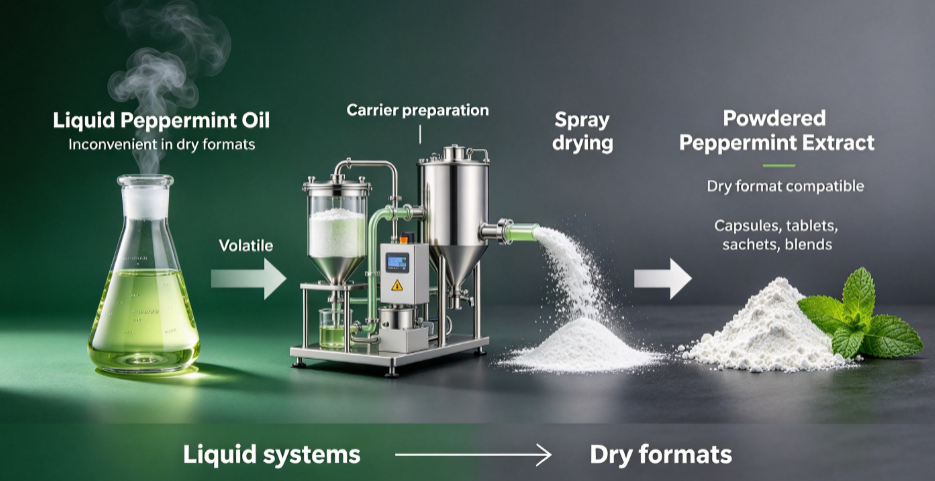
Peppermint oil extract powder is not the same as ground dried peppermint leaves. It is liquid peppermint essential oil that has been microencapsulated or spray-dried onto a carrier material — typically maltodextrin, modified starch, or cyclodextrin — to produce a dry, free-flowing powder that releases the oil when dissolved or processed.
The encapsulation step matters more than most buyers realize. Done well, it protects the volatile menthol fraction from oxidation and evaporation during storage, controls the rate of flavor release in a finished product, and makes an otherwise difficult-to-handle liquid compatible with dry manufacturing processes. Done poorly — thin shell walls, inadequate barrier properties, wrong carrier selection — the powder loses menthol content rapidly during storage and delivers inconsistent flavor performance in the finished product.
This is why two suppliers can both quote “peppermint oil powder 10%” and deliver very different products. The menthol retention after 12 months of storage at ambient conditions is the real performance test, not just the day-one percentage on the COA.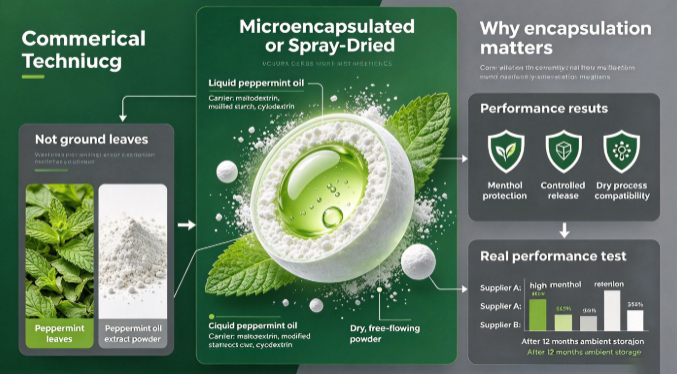
Natural peppermint oil contains menthol as the dominant compound — typically 40–55% — alongside menthone, menthyl acetate, menthofuran, and other volatile components. The ratio between these compounds is not fixed across all peppermint oil sources and it affects how the finished product performs.
Menthol drives the cooling sensation — the classic peppermint experience on mucous membranes and skin. High menthol content produces an intense, clean, cool profile. Menthone contributes warmth and herbal complexity to the flavor. High menthone ratios give a slightly heavier, more medicinal peppermint character that some food applications find less desirable but that pharmaceutical oral care formats sometimes prefer.
Indian peppermint oil — the dominant commercial source globally — typically runs higher menthol content than Chinese or US peppermint oil. For food and confectionery applications where a clean, sweet peppermint flavor is the objective, high-menthol Indian origin material is generally the starting point. For oral care and pharmaceutical applications with different sensory requirements, the menthol/menthone balance needs to match the product spec rather than default to the highest menthol option.
When sourcing peppermint oil extract powder, the GC/MS profile of the underlying oil should be part of the documentation — not just the encapsulated powder’s overall menthol percentage. Two powders at 10% menthol can smell and taste quite different depending on the full volatile compound profile of the oil they were made from.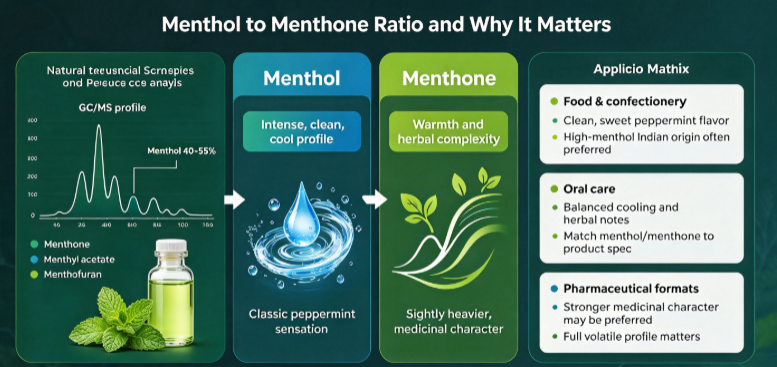
Confectionery is the largest application. Hard candy, chewing gum, breath mints, and chocolate peppermint formats all use encapsulated peppermint oil powder to deliver consistent flavor in dry processing environments. The encapsulation protects flavor during high-temperature hard candy production and controls release timing in chewing gum — an application where flavor longevity is a genuine product feature.
Dietary supplement capsules and tablets are a major segment. Powdered peppermint oil extract works in direct compression tablet formulations and capsule fills where liquid oil cannot be used. The encapsulated format also reduces the strong flavor intensity of peppermint oil at the point of ingestion, which improves palatability compared to liquid oil in capsules.
Oral care dry formats — effervescent tablets, tooth powder, dry mouthwash formats — use peppermint extract powder for flavor delivery in water-free systems. The powder format dissolves on contact with moisture and releases the volatile oil fraction for immediate sensory impact.
Spearmint extract powder is worth mentioning separately. Spearmint — Mentha spicata — produces carvone rather than menthol as its primary volatile compound. The flavor profile is distinctly different from peppermint — sweeter, less cooling, more herbal. Spearmint extract powder follows a similar production logic to peppermint oil powder but targets different applications — particularly where a milder, less intense mint character is preferred. The two are not interchangeable in formulations and should not be treated as equivalent options.
Personal care and cosmetics use powdered mint extracts in sheet masks, dry cleansers, bath salts, and dry scrub formats where liquid oil incorporation is impractical. The controlled release from encapsulated powder gives a more gradual sensory experience than direct liquid oil contact.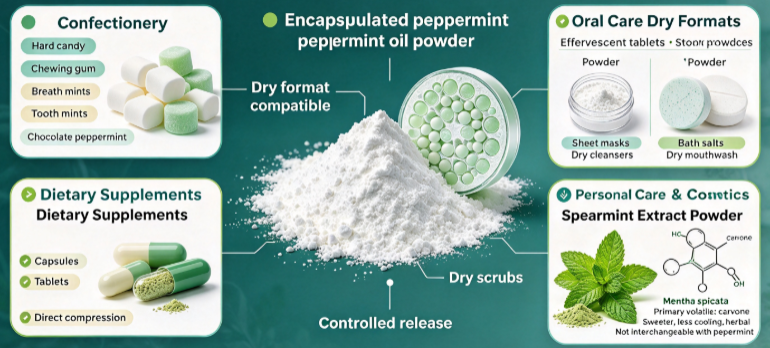
Menthol content should be HPLC-verified by batch, not estimated from the encapsulation ratio. Shell integrity affects the actual menthol retained in the powder significantly, and batch testing gives you the real number rather than a theoretical calculation.
Carrier type should be disclosed. Maltodextrin is the most common and cost-effective carrier. Cyclodextrin encapsulation produces better flavor retention and more controlled release but costs significantly more. Modified starch gives different release kinetics than either. The carrier choice matters for how the powder behaves in your formulation and should match your intended application.
Flowability specification is a practical concern for dry manufacturing. Peppermint oil powder needs to blend uniformly with other dry ingredients. Bulk density and Carr Index values that fall outside acceptable ranges for your equipment create processing problems that show up at scale.
Moisture content should be below 5% for adequate shelf life. Peppermint oil powder is sensitive to humidity — moisture uptake softens the shell and accelerates menthol loss. Moisture-barrier packaging is non-negotiable for commercial volumes, and moisture content should be batch-verified.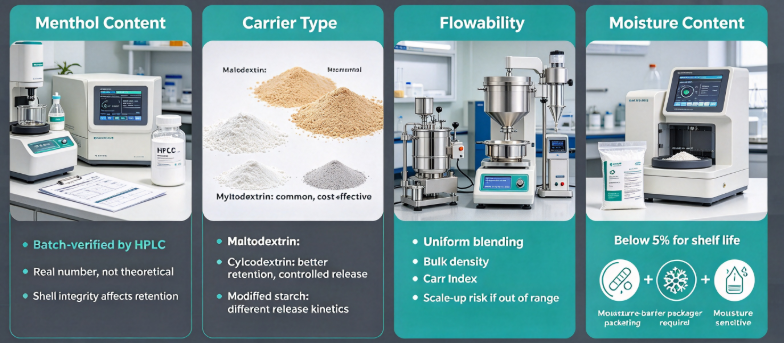
1、What is the difference between peppermint oil extract powder and peppermint leaf extract?
Peppermint oil extract powder is encapsulated liquid peppermint essential oil in dry powder form. Peppermint leaf extract is a concentrated preparation from dried leaf material. They have different menthol concentrations, flavor profiles, and suitable applications.
2、Can powdered peppermint be used in tablet manufacturing?
Yes. The dry, free-flowing format of encapsulated peppermint oil powder is specifically suited for direct compression tablet manufacturing where liquid oil cannot be incorporated directly.
3、What is spearmint extract powder and how is it different from peppermint?
Spearmint extract powder is produced from Mentha spicata and contains carvone as its primary active compound rather than menthol. The flavor is sweeter and less cooling than peppermint, making it appropriate for different food and personal care applications.
We supply peppermint oil extract with complete COA documentation and clearly defined product specifications. Sample requests and quotes are available directly from our sales team.





