
Key takeaways
Two quotes for Strawberry Fruit Powder land on the same desk. One is nearly double the other. The usual guess is that the expensive supplier is padding its margin. Often it is simply selling twice as much strawberry. You can check this with a calculator and no help from either supplier.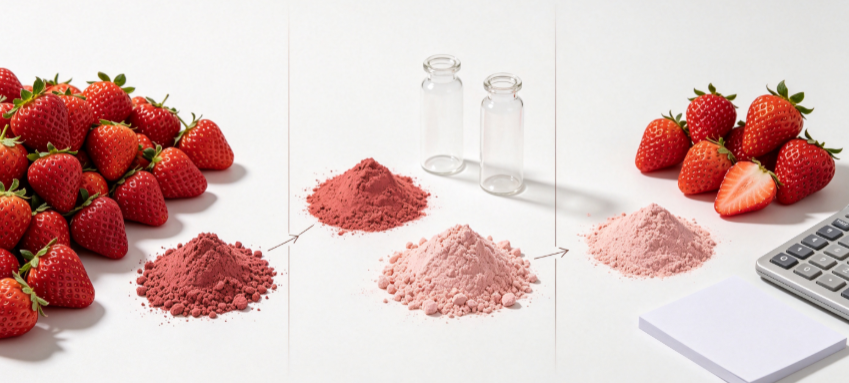
Here is how we work it out. These are working assumptions, not lab results, and every factory differs a little.
For pure freeze dried powder, one kilo of finished product holds about 0.96 kg of fruit solids. Divide by 0.09 and you need about 10.7 kg of trimmed fruit. Divide again by 0.92 for the trimming loss, and you land near 11.6 kg of berries bought.
| Powder type | Fruit in the powder | Fresh berries per kg of powder (approx.) |
|---|---|---|
| Freeze dried, whole fruit | about 100% | 11 to 12 kg |
| Fruit powder with 30% carrier | about 70% | about 8 kg |
| Fruit powder with 50% carrier | about 50% | about 6 kg |
Those lower figures assume every bit of fruit solids ends up in the powder. Pressing juice leaves some behind in the pomace, so real numbers run a little higher.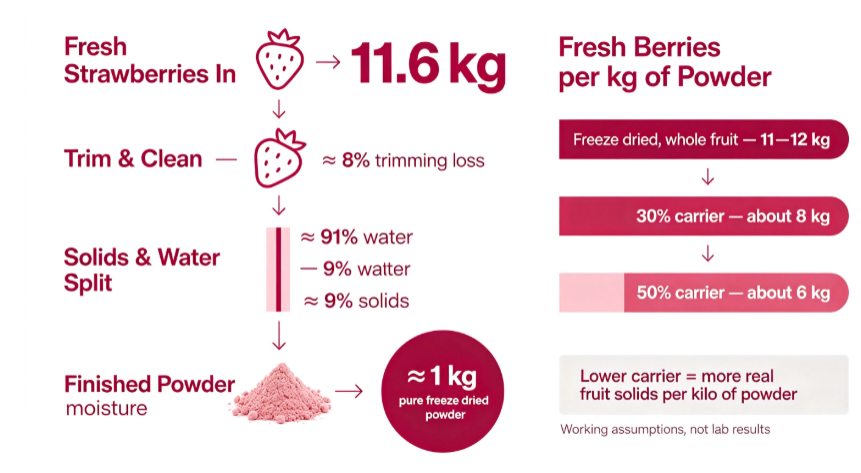
Most strawberry juice powder is spray dried with a carrier, usually maltodextrin, because fruit sugars turn sticky in a dryer. The carrier share varies a lot from product to product, and the spec sheet decides whether you ever see it.
So a powder with half carrier costs less per kilo for a simple reason. It holds half the fruit. The fair comparison is price divided by the fruit fraction. If Quote A costs twice as much as Quote B but holds twice the fruit, they cost the same per kilo of strawberry. And if A holds more than twice the fruit, the dearer quote is actually the better deal.
That is why we always say the carrier percentage out loud. It is not a secret ingredient and nobody should treat it like one. For some products, a lower carrier grade is exactly what you want. For others, a lighter, cheaper juice powder works perfectly.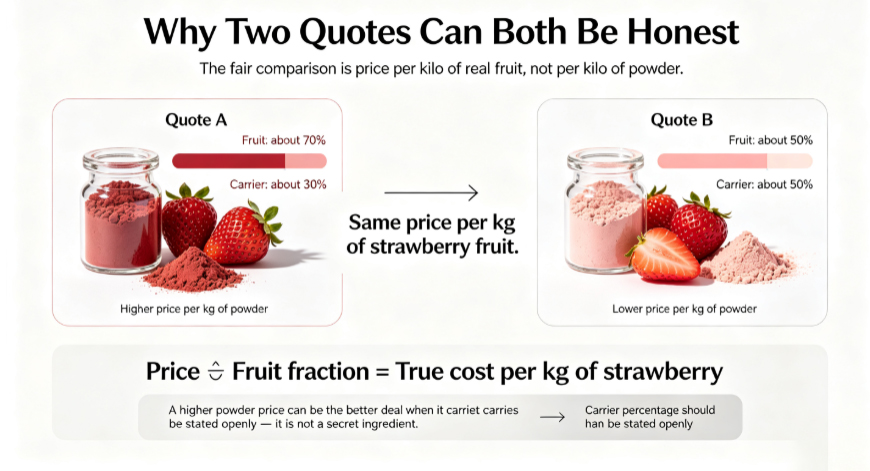
Arithmetic gets you to a fair price. It does not get you a good powder. A few things the calculator can't see:
If you need a number on a label rather than a flavor, a strawberry fruit extract is another route. It is sold on a ratio or a marker, and it is a different ingredient with a different price logic.
For bulk strawberry powder, our advice is simple. Ask for the fruit percentage, the carrier type and the moisture. Then test a small sample in your own base, hot and cold, before you order volume.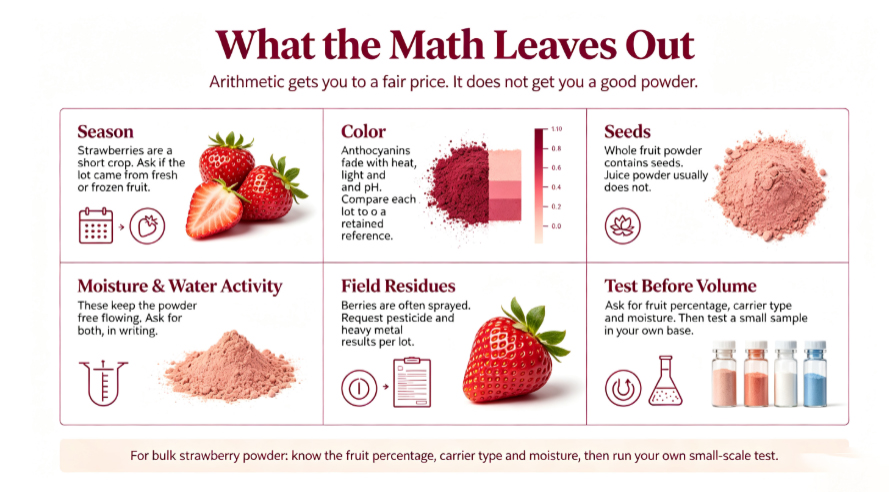
If you want a supplier who tells you the fruit percentage up front, send us your use case and we'll suggest a spec. You can start with our premium bulk strawberry fruit powder. We supply it with complete COA documentation and clearly defined product specifications. Sample requests and quotes are available directly from our sales team.





