
Sage leaf extract is one of those botanical ingredients where the COA conversation reveals a lot about how well a supplier actually understands their own product. Ask three different suppliers for sage leaf extract and you might get three different standardization markers — one quoting rosmarinic acid, one quoting ursolic acid, one quoting total polyphenols. All technically valid. None interchangeable.
If you do not know which one your application needs, you are making a sourcing decision based on incomplete information.
Rosmarinic acid is a hydroxycinnamic acid ester found in significant concentrations in Salvia officinalis leaves. It is the most commonly specified marker for sage leaf extract in cosmetic and supplement applications targeting antioxidant activity. A standardization of 1% to 5% rosmarinic acid by HPLC is typical for general supplement and cosmetic-grade material. Because rosmarinic acid is also present in high concentrations in rosemary — Salvia rosmarinus, formerly Rosmarinus officinalis — it is not a species-specific marker for sage. It tells you something about antioxidant potential but nothing definitive about botanical identity.
Ursolic acid is a pentacyclic triterpenoid present in sage leaf wax and is associated with the ingredient’s use in cosmetic formulations for skin firming and anti-aging applications. Ursolic acid standardization typically runs 0.5% to 2% for cosmetic-grade sage extract. It is more specific to applications targeting skin structure support than rosmarinic acid, and some cosmetic formulators specifically request ursolic acid standardization for this reason.
Total polyphenols is the broadest specification — it captures the full phenolic content of the extract without isolating any single compound. Expressed as a percentage by UV spectrophotometry or HPLC, it is a useful general quality benchmark but less informative for specific functional applications than either rosmarinic acid or ursolic acid alone.
Knowing which marker aligns with your application and target market documentation requirements is the question to answer before approaching suppliers.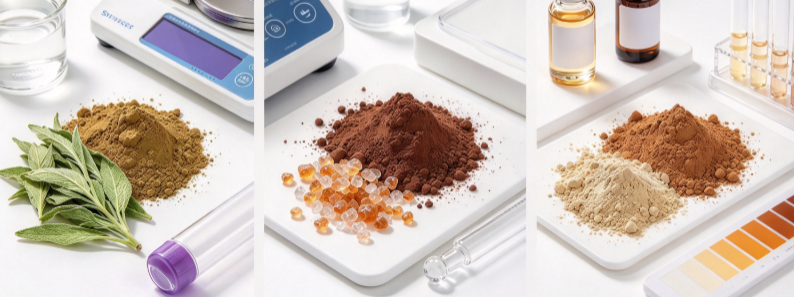
The genus Salvia contains over 900 species. Commercial sage leaf extract for food, supplement, and cosmetic applications uses Salvia officinalis — common sage — as the source plant. The problem is that other Salvia species and even non-Salvia plants sometimes appear in supply chains under the loose term “sage.”
Clary sage — Salvia sclarea — is a different species with different essential oil chemistry, primarily used for its essential oil in fragrance and cosmetic applications. It has genuinely different active compounds from Salvia officinalis and is not an equivalent substitute in formulations designed around the officinalis profile.
Spanish sage — Salvia lavandulifolia — has a similar rosmarinic acid profile to common sage but a different essential oil composition, lower in thujone. For some European markets this distinction matters because Salvia lavandulifolia has lower thujone content and is preferred for certain food applications where thujone limits apply.
Any supplier of sage leaf extract should be able to confirm Salvia officinalis as the source species by name on the COA. Botanical identity verification by microscopy or HPLC fingerprinting is appropriate for buyers sourcing at volume where species consistency across batches matters.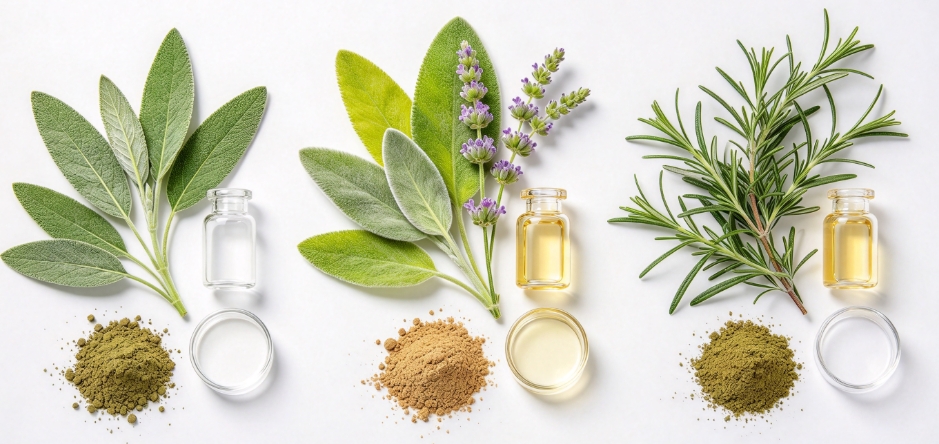
Food and beverage is the largest application segment for sage extract globally. Sage is one of the most commercially important culinary herbs, and the extract form appears in natural flavor systems, functional teas, herbal drink blends, and as a natural preservative in processed meat and dairy products. The antimicrobial properties of sage volatile compounds — particularly thymol and carvacrol — give it genuine preservative functionality beyond flavor. Natural preservation is a growing driver in the food industry as brands reformulate away from synthetic preservatives.
Cosmetics and personal care is a rapidly expanding segment. Sage leaf extract appears in anti-aging serums, scalp care products, facial toners, and body care formulations. The combination of rosmarinic acid for antioxidant activity and ursolic acid for skin-firming positioning makes it a multi-functional cosmetic active. Sage extract’s natural antimicrobial properties also make it relevant as a functional ingredient in natural deodorant and scalp health formulations where bacterial control is part of the product mechanism.
Dietary supplements use sage leaf extract in capsule and tablet formats. Sage leaf supplement products have a well-established commercial presence in European markets particularly, where traditional herbal use backing supports consumer familiarity. Sage leaf extract capsules and sage leaf powder in capsule format are the most common delivery forms for retail supplement applications.
Pharmaceutical applications in European markets where sage preparations have traditional herbal registration — particularly for throat and mouth applications — represent a more regulated but commercially meaningful segment.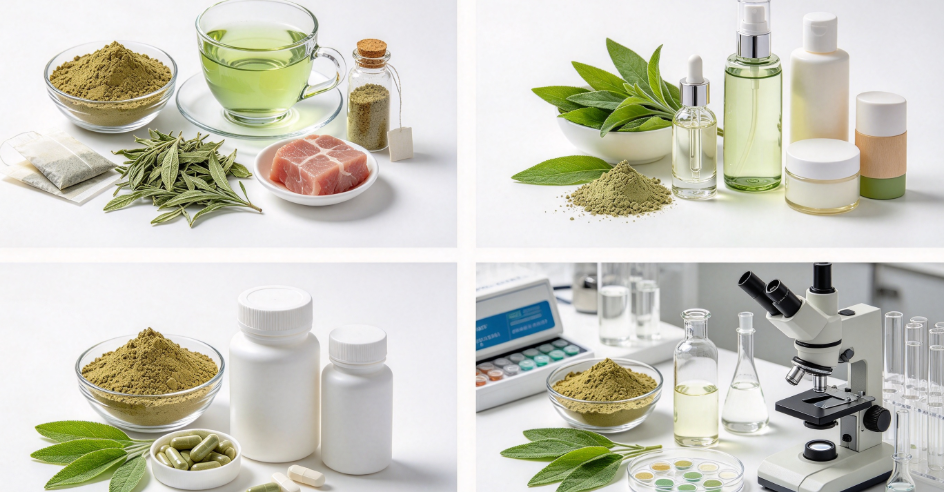
Thujone content is a regulatory consideration that affects sage extract in food applications. Thujone is a monoterpene ketone present in sage essential oil that is regulated as a food additive in the EU — maximum limits apply in different food categories under EC 1334/2008. For food-grade sage extract intended for European markets, thujone content should be tested and documented by batch. Supplement-grade material for capsule applications is subject to different considerations than food applications.
Essential oil content versus polyphenol content varies significantly depending on whether the extraction process targets the volatile oil fraction or the water-soluble polyphenol fraction. Hydroethanolic extraction concentrates both. Water extraction pulls polyphenols effectively but misses volatile compounds. Steam distillation captures essential oils but not polyphenols. The extraction method should match the intended application — a cosmetic formulator who needs both ursolic acid and the aromatic character of sage needs a different extract than a food manufacturer using sage purely as a polyphenol antioxidant.
Pesticide residue testing by lot is relevant for sage from major producing regions. Spain, Turkey, Albania, and China are primary commercial sources. Agricultural practices vary significantly and lot-specific pesticide screening is the appropriate standard for food and supplement applications entering EU or US markets.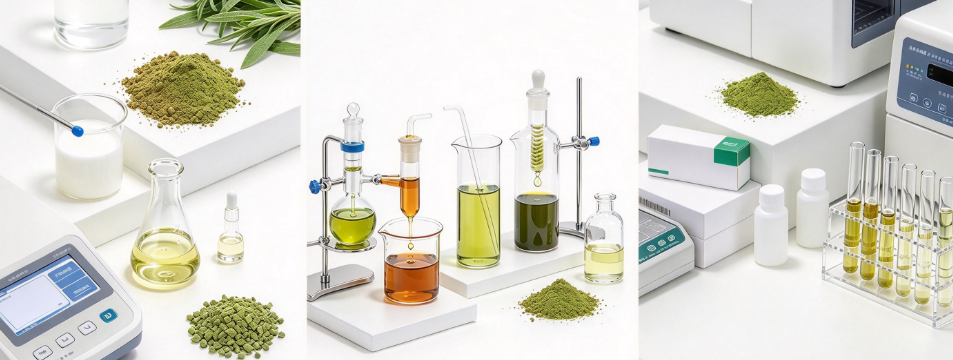
1、What is the standard rosmarinic acid content in sage leaf extract for supplement use?
Commercial supplement-grade sage leaf extract is typically standardized to 1% to 5% rosmarinic acid verified by HPLC. Higher concentrations are available for specific cosmetic applications targeting antioxidant activity.
2、Is sage leaf extract the same as rosemary extract?
No. Both are in the Salvia genus and share rosmarinic acid as a common marker, but they are different species with different essential oil profiles and different traditional use histories. Salvia officinalis is sage; Salvia rosmarinus is rosemary.
3、Can sage leaf powder be used in place of standardized sage extract in capsule formulations?
Yes, but with lower and more variable active compound content. For products requiring consistent rosmarinic acid or ursolic acid dosing per capsule, standardized extract is the appropriate choice over whole leaf powder.
We supply sage leaf extract with complete COA documentation and clearly defined product specifications. Sample requests and quotes are available directly from our sales team.





